Renewable Energy Certificates
Making Green Energy Verifiable

Aybars Dorman
Стратег систем будущего и автор Dorman Review
Renewable Energy Certificates • Making Green Energy Verifiable
More than 3,000 companies around the world have promised to reach net zero, and in 2023 alone they signed a record 36 to 37 gigawatts of clean power deals, according to BloombergNEF.
Almost every one of them now says it runs on renewable energy. But here is the problem. Once electricity enters the grid, it looks exactly like every other unit of power in the wires. Solar, wind, coal, and gas all blend into one stream. So how can a company actually prove that the energy it used was clean?
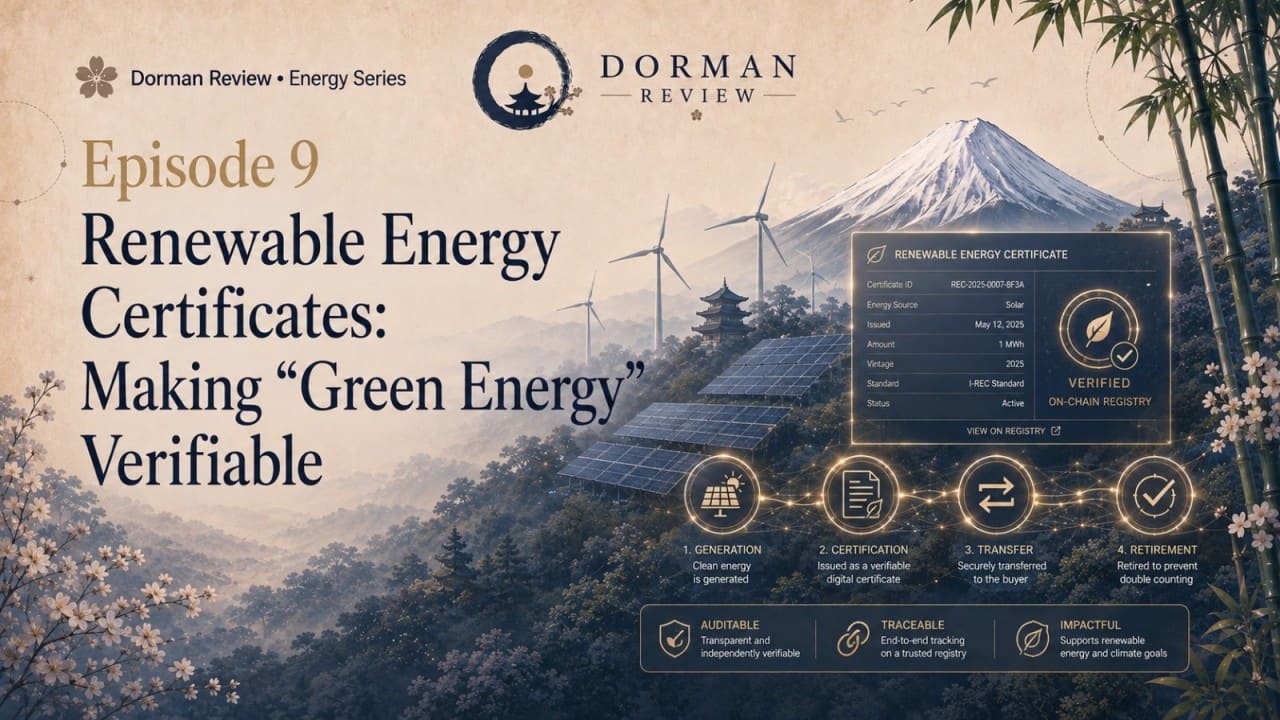
This is where Renewable Energy Certificates, or RECs, come in. A single REC stands for one megawatt-hour of electricity that was produced from a renewable source and delivered to the grid. It also records where and when that electricity was made. Because the certificate can be bought and sold separately from the electricity itself, a company can support clean power even if it cannot physically receive that exact power. Once a REC is used to support a claim, it is retired, which means the same megawatt-hour cannot be counted twice.
That is how it should work. The challenge is making sure every certificate is issued correctly, tracked properly, and retired only once, across a market that is now worth somewhere between $15 billion and $30 billion a year, depending on which research firm you ask. When even the size of the market for proving green energy cannot be agreed on, it tells you how messy the data still is.
Blockchain could fix part of this by keeping a shared, transparent record of every step in a certificate's life.
Generation → Certification → Transfer → Retirement
With that full history, the risk of double counting drops, audits become easier, and companies can report their renewable energy use with much more confidence. This matters more now than it did a year ago, because the rules are getting stricter. The GHG Protocol, the most widely used carbon accounting standard in the world, is proposing in its 2026 Scope 2 update that companies move toward 24/7 hourly matching and tighter rules on where the energy comes from. The final version is expected in 2027. Under these rules, buying cheap certificates from a faraway grid to cover a yearly total may no longer be enough. Companies will need to show that clean energy was actually being produced at the same time they were using it, hour by hour.
Recommended by LinkedIn
Traditional certificates were never designed for that. Most RECs and Guarantees of Origin are still issued monthly or yearly, which hides the truth about which hours were clean and which were not. New approaches are starting to close this gap. The EnergyTag standard defines hourly, time-stamped certificates. Energy Web has built 24/7 matching on-chain. And companies like Blok-Z, working with EnerjiSA, the E.ON and Sabancı joint venture in Turkey, are already using blockchain-based hourly matching so energy retailers can prove where the power they sell came from, without the risk of greenwashing.
However, blockchain alone does not prove that the electricity was truly renewable. A ledger is only as honest as the data written into it. If a meter reading is wrong, or a generation record is faked before it reaches the chain, the blockchain will store that mistake forever. The physical generation data still has to be accurate and checked by an independent party before anything is recorded.
Once again, the principle holds. Digital transparency is only as strong as the data behind it.
The real opportunity is to connect physical energy production with digital records that people can trust, from the meter, to the certificate, to the final claim. Get that connection right, and green energy claims stop being a matter of trust and become something that can be measured, audited, and believed.
Next: 2030. When AI, IoT, and Web3 converge in energy.
Written by Aybars Dorman | 7 September 2026
#RenewableEnergy #RECs #Blockchain #EnergyTransition #Sustainability #ESG #CleanEnergy #CarbonAccounting #DormanReview