Bitcoin and Energy
Myths, Facts and Green Mining

Aybars Dorman
Estratega de Sistemas Futuros e Autor da Dorman Review
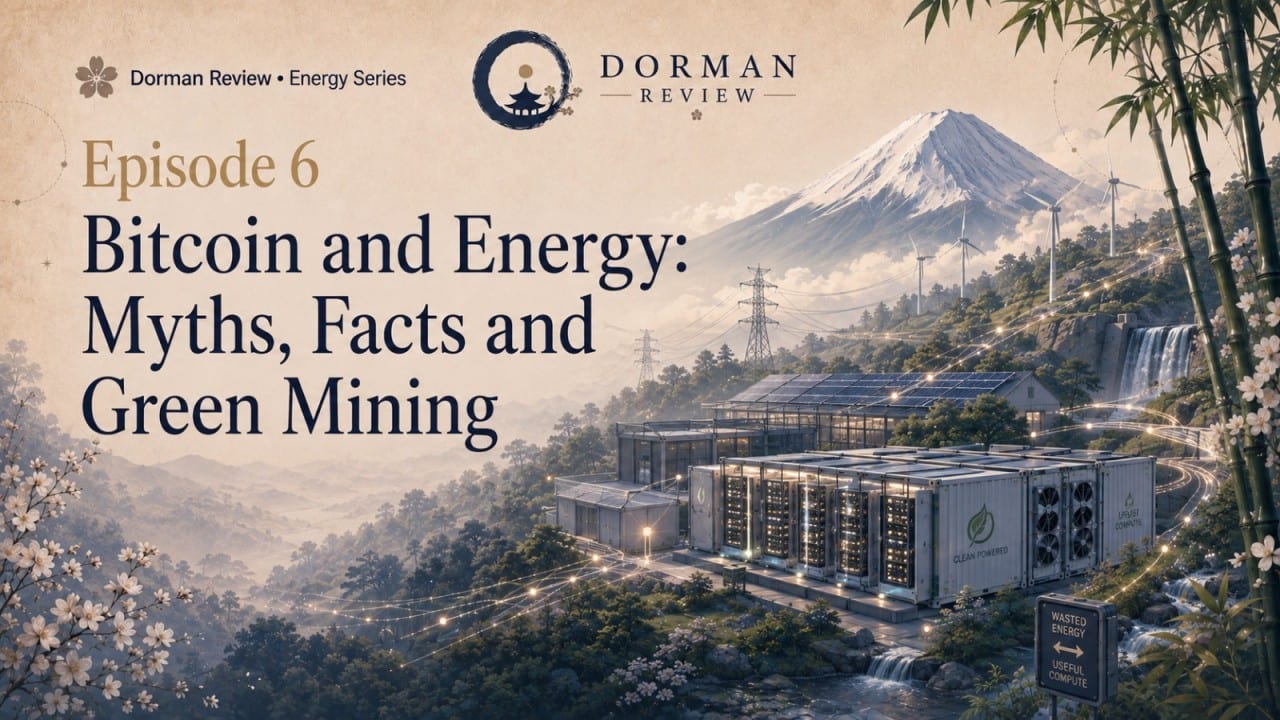
Bitcoin and Energy • Myths, Facts and Green Mining
Few topics create more debate than Bitcoin's energy consumption.
Bitcoin secures its network through Proof of Work, which means real computers doing real work, and burning real electricity to do it.
That criticism is legitimate. By Cambridge's latest estimate, Bitcoin mining now draws somewhere between 170 and 180 TWh a year, roughly 0.7. 0.8% of global electricity consumption.
But most of the debate stops at that one number. It rarely asks the more useful question: where does that electricity actually come from?
Cambridge's most recent industry survey puts 52% of Bitcoin's mining mix on sustainable sources, nuclear and renewables combined, up from 38% in 2022. Hydropower alone supplies close to a quarter of the network.
Some of that energy isn't just clean. It's reclaimed.
Oil wells routinely flare natural gas they have no pipeline to sell. The world flared 151 billion cubic meters of it in 2024 alone, enough to power two-thirds of Europe. Companies like Crusoe Energy started plugging mobile data centers directly into those wellheads instead, mining Bitcoin on gas that would otherwise just burn into the sky. Crusoe alone has captured over 22 billion cubic feet of it, cutting emissions by an estimated 2.7 million tons of CO2. Cambridge now counts more than 500 MW of global mining capacity running on stranded gas like this.
So, can Bitcoin mining turn wasted energy into an economic resource?
In specific, documented cases, yes. But the answer still depends entirely on the site: the energy source, the location, the grid it's competing with.
Recommended by LinkedIn
This is also why lumping Bitcoin and Ethereum together stopped making sense years ago.
Ethereum abandoned Proof of Work in 2022. The Merge cut its energy use by more than 99.9%, dropping the carbon cost of a single transaction from around 110 kg of CO2 to essentially zero.
Same industry. Completely different energy story.
So the honest takeaway isn't that crypto is 'green' or that crypto is 'bad.' Both labels flatten a genuinely complicated system into a slogan.
The real questions are narrower, and far more useful: What kind of energy is being used? Where does it come from? What economic value does it create once it's used?
Answer those, and the Bitcoin energy debate stops being a talking point and starts being an actual analysis.
Next: Electric Vehicles • What if your car could become part of the power grid?
Written by Aybars Dorman | 26 August 2026
#Bitcoin #Energy #Sustainability #GreenMining #CryptoESG #ClimateTech #Blockchain #DormanReview