Smart Contracts and Smart Grids
Can Energy Markets Become Autonomous?

Aybars Dorman
Estratega de Sistemas Futuros y Autor de Dorman Review
Smart Contracts and Smart Grids • Can Energy Markets Become Autonomous?
Energy demand changes every second, and so does energy supply. Solar generation depends on how much sunlight is available, wind generation depends on the weather, and electricity demand shifts constantly throughout the day.
Managing all of this complexity requires systems that are far more intelligent than the ones most grids run on today.
This is where smart contracts start to become genuinely useful. A smart contract is essentially a set of rules that executes automatically once predefined conditions are met, without anyone needing to approve each transaction by hand.
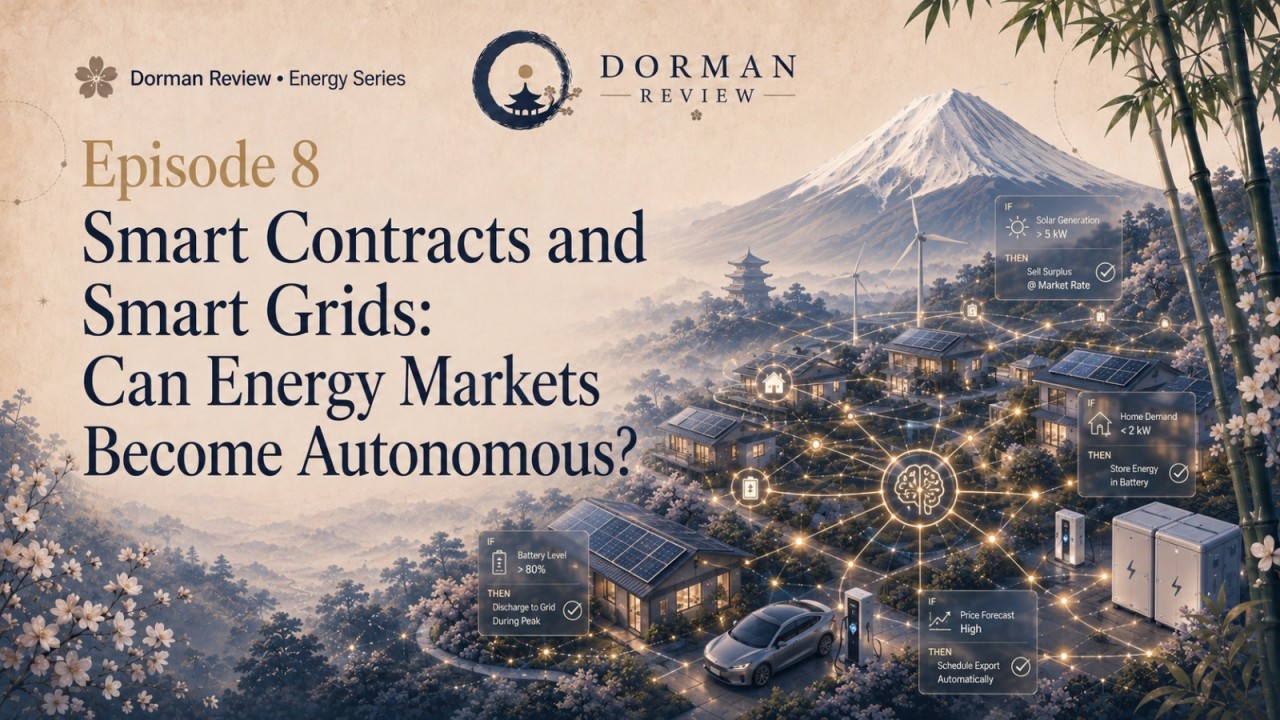
In an energy system, that could look like this: if electricity demand increases, the price adjusts automatically. If a battery reaches a certain charge level, it discharges on its own. If renewable energy becomes available, connected devices prioritise it over the grid. And once a transaction is completed, payment is triggered instantly, with no invoice, no delay, and no manual reconciliation.
This isn't just a theoretical idea anymore. The blockchain-in-energy market is on track to grow from roughly $2.8 billion in 2025 to close to $10 billion by 2031, and the fastest-growing part of that market is exactly this: smart contracts built specifically for battery and EV fleet dispatch, expanding at nearly 29% a year.
In early pilots already running today, this kind of automated settlement has cut transaction processing time by up to 65% compared to manual reconciliation, and improved billing efficiency by roughly 48% compared to traditional centralised metering.
The result, at least in theory, is a more responsive energy market, one where a meaningful share of decisions can happen automatically across connected devices, instead of relying on someone manually approving every transaction.
But smart contracts cannot physically control a power grid on their own. Code can only act on the information it receives, which means the whole system depends on reliable data flowing in from sensors, meters, and other physical infrastructure.
That link is already forming: more than 60% of the advanced smart meters being deployed today are built to be blockchain-compatible from the start, which is exactly the missing piece this kind of system needs.
This is why the real opportunity doesn't lie in any single technology, but in combining several of them: IoT, AI, blockchain, and smart grids, working together rather than in isolation. Companies like Siemens, IBM and Power Ledger are already building pieces of this stack, and together they account for well over half of the current market.
The goal here isn't simply to automate energy transactions for the sake of automation. It's to build an energy system that can genuinely sense what's happening, decide what to do about it, and respond, all without waiting for a human to step in first.
Next episode is Renewable Energy Certificates • Can we prove that energy is truly green?
Written by Aybars Dorman | 1st September 2026
#SmartContracts #SmartGrid #Blockchain #EnergyMarkets #IoT #ArtificialIntelligence #CleanTech #EnergyTransition #DormanReview